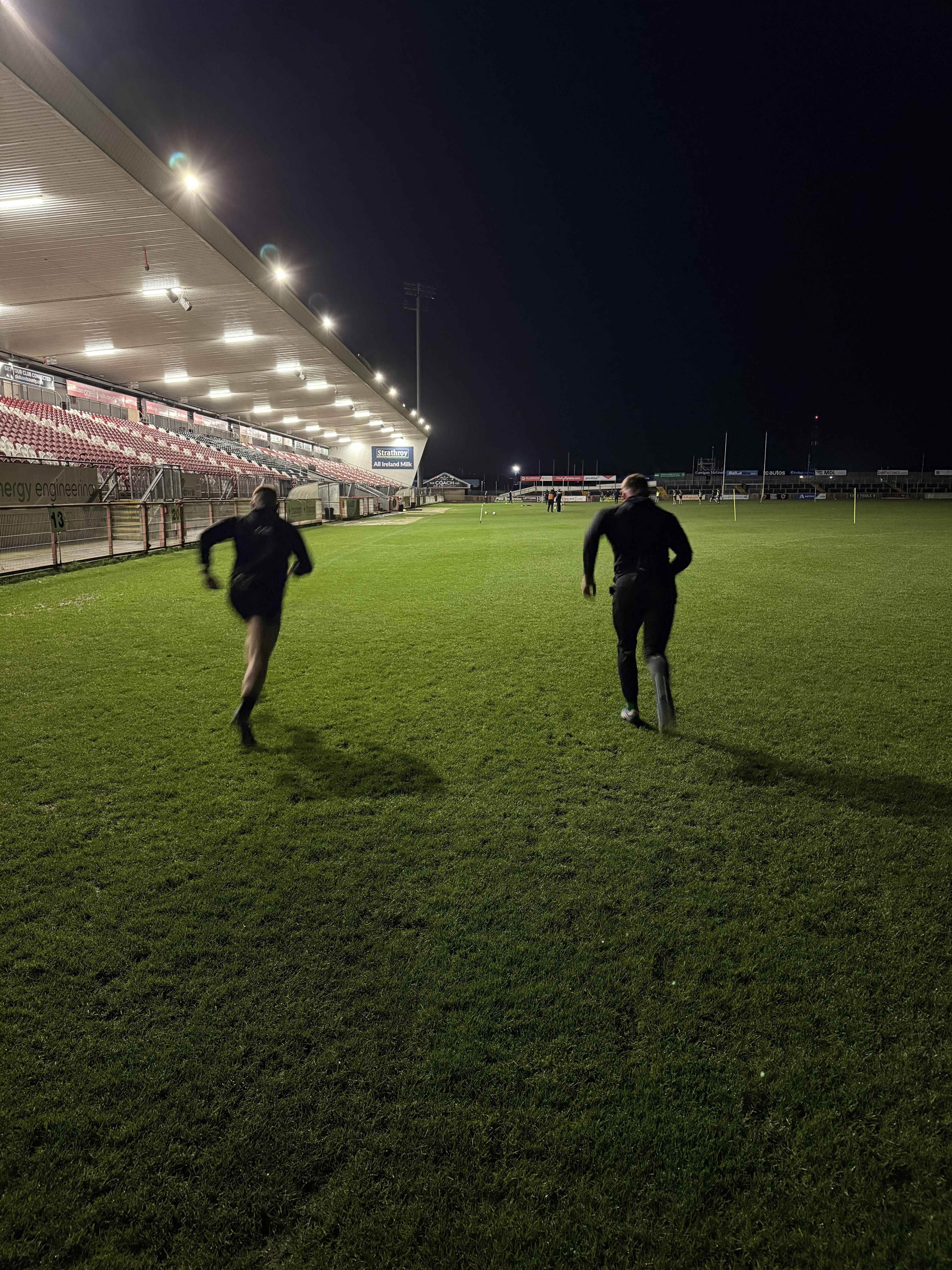
Most club players I meet train hard. They just train blind — random gym sessions with no real link to the season, the pitch, or the fixture list. They'll hammer a heavy leg session on the Thursday, play on the Saturday, and wonder why they feel flat. Or they'll do nothing all winter, then panic-train in January and pull a hamstring by March.
None of that is a work-rate problem. It's a structure problem. And structure is what separates the S&C that actually makes you better from the S&C that just makes you tired.
Here's how to think about it — the same way I'd programme it for an inter-county panel, scaled to a club player's life. And it's grounded in research done on Gaelic games players specifically, not borrowed from other sports — the key studies are listed at the end.
Why S&C matters for GAA in the first place
Gaelic football and hurling are repeated-sprint, collision, change-of-direction sports. You accelerate, decelerate, turn, jump and take contact, over and over, for 60-plus minutes. Every one of those qualities sits on top of one foundation: strength.
But there's a second reason that matters just as much — staying on the pitch. The injury numbers in Gaelic games are sobering: lower-limb injuries are the most common problem, and they happen far more often in matches than in training, with the hamstring the single most-injured area (O'Malley et al., 2014). If you want to be available in September, robustness isn't optional — and strength is one of your best tools for it.
Strength keeps you on the pitch — the evidence
This isn't a hunch. A large meta-analysis across sports found that strength training substantially reduced injuries, with a clear dose-response — the more consistent strength work athletes did, the greater the protection (Lauersen et al., 2018).
And in Gaelic games specifically, structured injury-prevention work has been shown to matter. When collegiate footballers and hurlers ran the GAA 15 neuromuscular programme before training and matches, their injury rate dropped by around 66% compared with a control group (Schlingermann et al., 2018). Sixty-six percent. That's not a marginal gain — that's the difference between a season on the pitch and a season on the sideline.
Strength isn't the goal in itself. It's the thing that makes everything else on the pitch better — and the thing that keeps you out there long enough to use it.
The real problem: training in-season
Here's where most club players come unstuck. In the off-season there's time and energy to train. In-season, you've got two pitch sessions and a match every week — and if you bolt hard gym work on top of that with no plan, you don't get fitter. You get buried. This is a particular problem in the GAA, where players are amateurs juggling work or study, travel, and training, and often can't recover properly between sessions.
So the answer isn't "train more." It's matching the training to the phase of the year. Broadly, the GAA year breaks into three:
1. Off-season — build the base
This is your window to actually get stronger, because pitch demands are low. Two to three strength sessions a week on the big movements — squat, hinge (deadlift/RDL), push, pull — with the load progressing week on week. This is where you make the physical gains that carry you through the season.
2. Pre-season — convert strength to power
As the season nears, you shift some of that strength toward speed and power — jumps, throws, faster lifts and sprint work — while keeping enough heavy lifting to hold what you built. Running volume also ramps here to prepare you for match demands. The key is to ramp it gradually (more on that below).
3. In-season — maintain, don't chase
This is the phase people get wrong. In-season, the gym's job is to maintain your strength and power with the minimum effective dose — often just one or two short, sharp sessions a week, kept well away from match day. You are not setting PRs in July. You're arriving at the weekend fresh and firing.
The load-spike trap
The single biggest in-season mistake is spiking your training load — a big jump in volume or intensity after a quiet spell. Research in elite Gaelic football has linked rapid rises in workload to increased injury risk (Malone et al.), and it's a consistent finding across collision sports more broadly: it's the sudden spike, not the hard work itself, that tends to hurt you (Gabbett, 2016).
The practical takeaway is simple. Don't come back from a two-week holiday and do the hardest session of your life. Build steadily, keep your training relatively consistent week to week, and you avoid the sharp jumps that cause soft-tissue injuries.
What a normal in-season week looks like
For a typical club player in-season:
- Early week: one strength/power session — heavier but low volume, in and out.
- Midweek: pitch session.
- Two days before the match: nothing heavy — movement, mobility, maybe light speed work.
- Match day.
- Recovery built in around it all.
The exact layout flexes around your fixtures. The principle doesn't: hard gym work lives early in the week, and match day is protected.
Where players go wrong
- Lifting heavy the day before a match. You turn up leggy and blame the warm-up.
- No off-season. You skip the one window where getting strong is easy, then try to cram it in-season when it's hardest.
- Chasing soreness instead of progress. Feeling wrecked isn't a sign a session worked. Getting measurably stronger, faster or more resilient is.
- Skipping the warm-up / prep work. The GAA 15 exists and it works — using it is one of the most evidence-backed things a Gaelic games player can do (Schlingermann et al., 2018).
- Copying a random programme off the internet that was never built for a field sport, a season, or you.
The bottom line
You don't need to live in the gym. You need to train the right things at the right time of year — build strength in the off-season, sharpen it in pre-season, and maintain it intelligently in-season without spiking your load or frying yourself before matches. Do that consistently, add the injury-prevention basics, and you'll be faster, more physical, and — the part that wins seasons — still standing in the closing stages when others are cramping or crocked.
That's the whole game: not more training, better-timed training.
References
- O'Malley, E., Murphy, J.C., Gissane, C., Blake, C., & Mangan, S. (2014). Epidemiology of lower limb injury in Gaelic football and hurling. British Journal of Sports Medicine, 48, 646–647. doi:10.1136/bjsports-2014-093494.204
- Schlingermann, B.E., Lodge, C.A., Gissane, C., & Rankin, P.M. (2018). Effects of the Gaelic Athletic Association 15 on lower extremity injury incidence and neuromuscular functional outcomes in collegiate Gaelic games. Journal of Strength and Conditioning Research, 32(7), 1993–2001. doi:10.1519/JSC.0000000000002108
- Lauersen, J.B., Andersen, T.E., & Andersen, L.B. (2018). Strength training as superior, dose-dependent and safe prevention of acute and overuse sports injuries: a systematic review, qualitative analysis and meta-analysis. British Journal of Sports Medicine, 52(24), 1557–1563. doi:10.1136/bjsports-2018-099078
- Gabbett, T.J. (2016). The training-injury prevention paradox: should athletes be training smarter and harder? British Journal of Sports Medicine, 50(5), 273–280. doi:10.1136/bjsports-2015-095788
- Malone, S., Roe, M., Doran, D.A., Gabbett, T.J., & Collins, K. (2017). High chronic training loads and exposure to bouts of maximal velocity running reduce injury risk in elite Gaelic football. Journal of Science and Medicine in Sport, 20(3), 250–254. doi:10.1016/j.jsams.2016.08.005